
Fine Needle Aspiration (FNA)
Ultrasound-guided fine needle aspiration for thyroid and neck lumps when clinically indicated

Medically reviewed by a board-certified ENT specialist
- Author:
- Dr. Poj Pinyopornpanish — Otolaryngologist · Thai Board of Otolaryngology
- Medical reviewer:
- Dr. Poj Pinyopornpanish — Otolaryngologist · Thai Board of Otolaryngology
- Reviewed on:
- Last updated:
- Estimated reading time: 5 min
Overview
What is fine needle aspiration (FNA)?
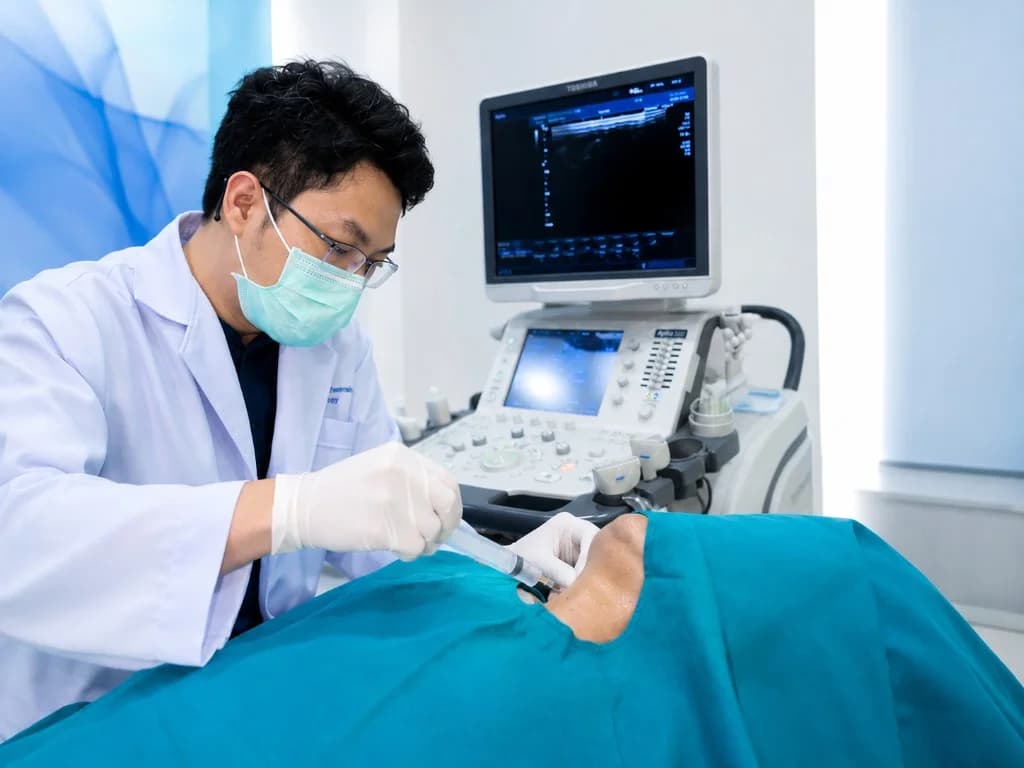
Fine needle aspiration (FNA) uses a thin needle to sample cells or fluid from a lump — such as a thyroid nodule, lymph node, or neck mass — for pathology examination.
When performed under ultrasound guidance, the doctor visualises the lump during sampling, improving accuracy of the sample site.
FNA is not major surgery. It is usually done in clinic or a procedure room and takes a short time. It is not required for every lump. Your doctor considers size, ultrasound features, symptoms, and clinical guidelines.
Symptoms
Symptoms you may notice
Many lumps cause no symptoms and are found on examination or ultrasound. When present, symptoms may include:
A lump felt at the front of the neck (thyroid) or under the jaw
A slowly growing or stable lump
Discomfort or tenderness over a lump (in some cases)
Hoarseness, swallowing difficulty, or breathing difficulty when a lump is large
Swollen lymph nodes in the neck
No symptoms — a lump found on ultrasound or examination
Possible causes
Lumps that may need FNA
FNA helps characterise lumps initially; not every lump requires it.
Thyroid nodules
Cysts or solid nodules in the thyroid. Most are not cancer, but FNA may be recommended when indicated.
Enlarged lymph nodes
May relate to infection, inflammation, or other causes — ultrasound features guide the decision.
Cysts or superficial lumps
Neck masses in soft tissue; FNA may confirm a cyst or other type in selected cases.
Thyroid inflammation
Some thyroiditis may cause nodularity; your doctor assesses whether FNA is needed.
Lumps needing cell confirmation
When ultrasound or examination shows features requiring cytology, according to guidelines.
Lumps for monitoring
Some lumps need follow-up ultrasound rather than FNA. Your doctor explains the care plan.
When to seek assessment
When to see an ENT specialist
Consider assessment if you have any of the following:
A new lump in the neck or thyroid area
A lump growing quickly
Ultrasound findings suggesting FNA should be considered
Worsening hoarseness, swallowing difficulty, or breathing difficulty
You want to understand the FNA procedure before deciding
Prior FNA results that need follow-up or repeat sampling
Diagnosis
How FNA is performed
Before FNA, your doctor reviews history, examines the neck, and assesses prior ultrasound or other tests.
During the procedure, you lie comfortably while the doctor uses ultrasound to guide a thin needle into the lump and aspirate cells or fluid. Several passes may be needed for adequate sampling. Local anaesthetic is usually applied.
Samples are sent for pathology. Results typically take a few days to one or two weeks, depending on the laboratory. Your doctor schedules a follow-up visit to explain findings and next steps. Not every result indicates cancer.
Treatment
Management after FNA results
Care depends on pathology results and lump characteristics. Not every lump requires surgery.
Monitoring
Reassuring FNA results may be followed with repeat ultrasound or examination at set intervals.
Repeat FNA or further tests
Non-diagnostic samples may require repeat FNA or additional investigation according to guidelines.
Thyroid condition treatment
If thyroid function is abnormal, medication or other care may be recommended.
Surgery
May be considered when FNA results or symptoms indicate — not as a first option for every nodule.
Coordinated care
Some patients may be referred to endocrinology or head and neck surgery based on results.
Why RAJVITHI CLINIC
Why choose RAJVITHI CLINIC
Sampling of neck and thyroid lumps is part of otolaryngology (ENT) care.
Systematic head and neck assessment by an ENT specialist
Ultrasound-guided FNA when clinically indicated
Clear explanation of procedure, risks, and result meaning in plain language
Evidence-based care — FNA is not ordered for every lump
Follow-up and referral planning based on pathology results
FAQ
Questions patients often ask
Is FNA painful?
Local anaesthetic is usually used. You may feel pressure or mild discomfort during sampling. Discomfort typically resolves quickly. Your doctor explains the steps.
Do I need to fast before FNA?
Usually not for thyroid or neck FNA. The clinic will advise if any special preparation is required.
How long does the procedure take?
The procedure typically takes about 15–30 minutes, including preparation and ultrasound guidance.
When will I get the results?
Pathology results usually take a few days to one or two weeks. Your doctor schedules a follow-up visit to explain findings.
Does FNA definitely diagnose cancer?
FNA helps classify cells in many cases, but some results are inconclusive or require repeat sampling. Your doctor explains what your result means.
Does every thyroid nodule need FNA?
No. Your doctor considers size, ultrasound features, symptoms, and clinical guidelines.
Are there complications?
Complications are uncommon. Minor bruising or temporary soreness may occur. Your doctor advises what to watch for afterwards.
Do I need an appointment?
Yes. Appointments are recommended, especially for ultrasound-guided FNA.
Where is RAJVITHI CLINIC?
1st Floor, MD Boutique Hotel, 18 Rajvithi Road, Chiang Mai
Is English consultation available?
Yes. The clinic sees international patients and English consultation is available.
References
Related guidelines and patient resources
The sources below are recognized international guidelines and patient-education resources for general learning. They are not individualized medical advice.
Thyroid nodule and fine-needle aspiration guidance
American Thyroid Association (ATA)
View source (American Thyroid Association (ATA))Patient education and clinical guidance in otolaryngology
American Academy of Otolaryngology–Head and Neck Surgery (AAO-HNS)
View source (American Academy of Otolaryngology–Head and Neck Surgery (AAO-HNS))Public ENT health information
ENThealth (AAO-HNS Foundation)
View source (ENThealth (AAO-HNS Foundation))
Educational information
Medical Disclaimer
This information is intended for educational purposes only and does not replace diagnosis or treatment by a qualified physician. If you have concerning symptoms, please consult an ENT specialist.
Related links
Learn more
Related clinic pages to help you explore conditions, services, and procedures.
Interested in fine needle aspiration?
Contact the clinic to book an appointment or ask preliminary questions. The doctor will assess your lump and advise whether FNA is appropriate.