
Loud snoring
Especially when sleeping on the back, or noticed regularly by others.
Snoring assessment and obstructive sleep apnea (OSA) evaluation by an ENT specialist—identify the cause and airway sites involved before selecting appropriate treatment.

Medically reviewed by a board-certified ENT specialist
Overview
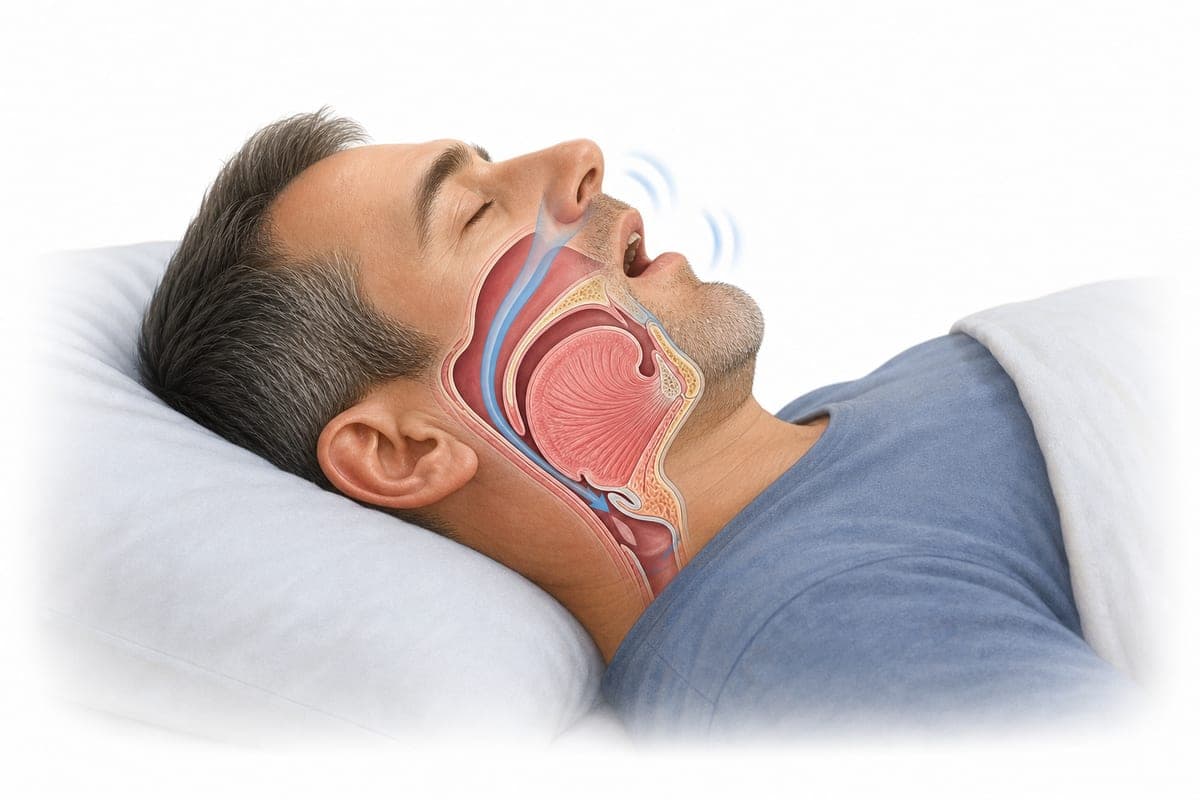
Snoring can result from narrowing or obstruction of the airway at several levels—from the nose and pharynx to the soft palate, uvula, and tongue base. Appropriate care therefore starts by finding the likely cause and site of the problem before choosing a treatment.
At RAJVITHI CLINIC, the physician assesses symptoms and upper-airway structure individually to distinguish primary snoring from possible obstructive sleep apnea (OSA).
Our approach is to assess clearly first, identify the cause and problem site, then select suitable treatment—aligned with “clear assessment • direct explanation • treat only as needed.” Snoring is the sound of soft-tissue vibration in a narrowed upper airway during sleep. OSA is repeated upper-airway collapse or narrowing that disrupts breathing and sleep. Loud snoring, witnessed pauses, or daytime symptoms deserve further evaluation.
Symptoms
Symptoms vary. If several are present—especially loud snoring with daytime sleepiness—an ENT evaluation is recommended.
Especially when sleeping on the back, or noticed regularly by others.
Breathing pauses, gasping, or choking during sleep.
Feeling sleepy despite adequate time in bed, or dozing during the day.
Waking unrefreshed or with headaches.
Reduced focus, memory changes, or mood irritability.
Persistent tiredness even when sleep duration seems sufficient.
Care pathway
A simple clinical pathway: see the doctor, evaluate the airway, then select snoring treatment based on individual findings.
Review sleep history, daytime symptoms, medical conditions, and related risk factors.
Examine the nose, throat, and upper-airway structures that may contribute to snoring.
Flexible nasal endoscopy when indicated to look for sites of narrowing or obstruction.
For people at risk or with symptoms suggestive of sleep apnea, a Home Sleep Test may be considered when clinically indicated.
Distinguish primary snoring from OSA and relate findings to areas that may contribute to obstruction.
Plan care based on cause, severity, and suitability for each person—not one pathway for everyone.
Assessment
Evaluation begins with a history of snoring, daytime symptoms, and risk factors, followed by an ENT examination of structures that may narrow the upper airway.
When clinically indicated, flexible endoscopy can be used to examine the nasal cavity and upper airway directly and identify areas that may contribute to narrowing or obstruction—important information before planning snoring treatment.
Endoscopy assesses anatomical structure. It does not diagnose obstructive sleep apnea (OSA) by itself. If OSA is a concern, sleep testing may be considered when appropriate.
Obstruction sites
To find where narrowing or obstruction may be occurring
Flexible nasal endoscopy helps the physician directly assess structures inside the nose and upper airway and identify areas that may contribute to narrowing or obstruction, such as:
Enlarged or swollen nasal turbinates
Deviated septum or nasal structure that narrows the airway
Inflamed or swollen nasal lining, for example from allergy
Polyps or other abnormalities inside the nasal cavity
Pharynx, soft palate, and uvula that may contribute to snoring or obstruction
People with similar snoring symptoms may have different causes and obstruction sites. Assessment helps the physician understand where the problem may lie and use that information for diagnosis and treatment planning.
Different roles of testing
These tests answer different questions and do not replace each other. Each is considered when indicated.
Used to assess anatomical structures and identify areas that may contribute to narrowing or obstruction of the upper airway. It does not diagnose OSA by itself.
Used when the physician sees a clinical indication, or in people at risk or with symptoms suggestive of obstructive sleep apnea, to evaluate abnormal breathing during sleep and assess whether OSA may be present and how significant it is. Not every person who snores automatically needs a Home Sleep Test.
Related services
Assess clearly → identify the problem site → choose suitable treatment. Radiofrequency is an option for selected patients—not the same treatment for everyone.
Inferior Turbinate Radiofrequency
Radiofrequency reduction of the inferior turbinates for selected patients when nasal obstruction contributes.
Learn more →Soft Palate Radiofrequency
Radiofrequency to reduce and tighten soft-palate tissue in appropriately selected patients after clinical assessment.
Learn more →Services
Core services that support assessment, diagnosis, therapy trials, and follow-up in one place—selected according to clinical indications after evaluation.
Specialist assessment of snoring, OSA risk, and care options.
Upper-airway structural evaluation to look for possible obstruction sites.
Home breathing study when the physician finds a clinical indication.
Clear explanation of results and treatment implications.
Device and mask trial with follow-up on comfort and use when indicated.
Considered for selected patients when turbinates contribute to obstruction.
Office-based option for carefully selected patients after assessment.
Considered when uvular anatomy contributes and indications are met.
Ongoing review of symptoms, CPAP use, or procedure outcomes.
Home Sleep Test
A Home Sleep Test records breathing and oxygen-related signals during sleep at home with portable sensors under clinical guidance. It is considered when the physician sees an indication, or in people at risk or with symptoms suggestive of sleep apnea. It is not required for every person who snores, and it does not replace every form of in-lab sleep study.
Adults with suspected OSA, appropriate clinical probability, and no features that require full laboratory polysomnography first. Suitability is decided by the physician.
Testing in a familiar environment, less travel burden, and useful data for planning when results are sufficiently informative.
Instruction on sensor placement, overnight recording as advised, then return of the device for analysis.
Your ENT specialist reviews apnea-related indices, oxygen patterns, and what they mean for CPAP or other options when indicated.
Treatment approach
After assessing symptoms, airway structure, and OSA risk, the physician selects options suited to the cause and problem site. Radiofrequency (RF) is one option for appropriately selected patients after medical assessment—not the default snoring treatment for everyone.
Such as allergy or nasal inflammation that may swell the lining and narrow the airway.
Sleep position, weight, alcohol before bed, or other related factors when appropriate.
Considered when OSA is diagnosed and positive airway pressure is clinically suitable.
Considered in selected patients when inferior turbinates contribute to obstruction after assessment.
Radiofrequency can reduce and tighten soft-palate tissue volume in appropriately selected patients and may help lessen soft-palate vibration that contributes to snoring. Selection is based on the obstruction site and cause after clinical assessment. For suspected or confirmed OSA, further evaluation—including sleep-study findings when indicated—may be needed before choosing treatment. Soft Palate RF does not cure snoring or treat OSA in every patient.
Considered in selected patients when uvular anatomy contributes after assessment.
Other options may follow anatomical findings and clinical diagnosis, including surgical consultation when clearly indicated.
CPAP Trial
CPAP is an important therapy for many people with OSA when indicated, but it is not appropriate for everyone. A supervised home trial helps assess comfort, adherence, and clinical response before longer-term planning.
Select and adjust a mask to reduce leaks and improve comfort.
Set initial pressure and features according to the clinical plan and usage data.
Review hours of use, side effects, and daytime symptoms during the trial.
Address dry nose, mask fit, or pressure discomfort so therapy can continue when still indicated.
Radiofrequency
Radiofrequency (RF) is one treatment option after medical assessment—not the starting snoring treatment for everyone. It may be considered for selected patients with suitable anatomy, such as turbinates, soft palate, or uvula. RF is not a universal substitute for CPAP in moderate-to-severe OSA.
Considered when enlarged or swollen turbinates contribute to obstruction in selected patients.
Radiofrequency can reduce and tighten soft-palate tissue volume in appropriately selected patients and may help lessen soft-palate vibration that contributes to snoring. It is selected from anatomical findings and clinical assessment. For suspected or confirmed OSA, treatment choice depends on overall airway assessment and sleep-study findings when indicated. Outcomes are not the same for every patient.
Considered when an elongated uvula contributes to snoring and indications are met.
Performed in clinic under local anesthesia for suitable candidates.
Temporary sore throat, swallowing discomfort, or mild nasal congestion can occur. Results vary with anatomy and severity; outcomes are not guaranteed to be identical for every patient.
Why Rajvithi
Clear assessment, direct explanation, and treat only as needed—with specialist care in Chiang Mai.
Upper-airway evaluation and planning by an otolaryngologist.
Nasal endoscopy and assessment of possible obstruction sites before planning care.
Home-based studies when indicated to support OSA evaluation.
Supported adaptation to CPAP under medical guidance when indicated.
Radiofrequency considered only for selected patients after assessment.
Plans tailored to findings, symptoms, and patient goals.
FAQ
Educational information only—not a substitute for individual medical advice.
Snoring alone is not always disease, but loud snoring with witnessed apneas, daytime sleepiness, or related medical conditions should be evaluated for OSA.
People with loud snoring, breathing pauses, significant daytime sleepiness, morning headaches, or risk factors such as obesity or hypertension should discuss testing with a physician. Not every person who snores automatically needs a Home Sleep Test.
It is useful for appropriately selected patients. It is not ideal for every situation; some people still need in-lab polysomnography based on clinical judgment.
No. Endoscopy assesses airway structure and possible obstruction sites. OSA evaluation is based on symptoms, risk factors, and sleep testing when the physician finds an indication.
Not always. CPAP is important for many OSA cases when indicated, but suitability depends on severity, cause, and response. Your clinician will help decide.
Radiofrequency (RF) is considered only for selected patients—for example when turbinates, soft palate, or uvula are involved and anatomy is suitable. It is not the starting snoring treatment for everyone, and not the primary option for every moderate-to-severe OSA case.
Mild sore throat or swallowing discomfort is common early on. Recovery timing varies; your doctor will give personalized aftercare advice.
Coverage depends on your policy and insurer. Check benefits before care and ask clinic staff if documentation is needed.
Snoring is a sound symptom. OSA is a disorder of repeated airway obstruction that affects breathing and sleep quality. Some people have both. Assessment helps distinguish them and plan care.
Not necessarily. Many pathways start with medical care, nasal treatment, CPAP trial, or minimally invasive options when indicated. Surgery is considered when clearly indicated.
Yes, if snoring is loud, mouth breathing is persistent, sleep is restless, or tonsils/adenoids may be enlarged. Avoid self-medication without assessment.
Usually not like before surgery. Follow the instructions provided with the device, including any advice about alcohol or sedatives.
CPAP keeps the airway open while in use and can reduce symptoms and health impact. It does not permanently remodel the airway by itself. Follow-up remains important.
Related links
Related clinic pages to help you explore conditions, services, and procedures.
Educational information
This information is intended for educational purposes only and does not replace diagnosis or treatment by a qualified physician. If you have concerning symptoms, please consult an ENT specialist.
If you or a family member has loud snoring, witnessed apnea, or daytime sleepiness, schedule an ENT assessment of cause and airway findings at RAJVITHI CLINIC in Chiang Mai.